Who I Voted for and What’s Next

In the 2026 US midterms, I voted not only from my bank account but from my heart. I voted for the people and values that shaped who I am, the women, the immigrants, Ukraine, and children. Here I explain why and point out what’s next.
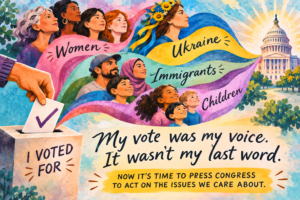
Graphic showing a diverse range of people, urging Congress to support the issues they care about.

Women

I believe a woman’s body is her own. A woman should have the right to decide whether to continue a pregnancy, in consultation with her doctor and her own conscience, not a legislature.

I feel this strongly because I know what it’s like to live in a body other people feel entitled to judge and control. I grew up in a world that taught me that one of the greatest accomplishments a woman could achieve was being thin. Overweight women were (and still are) seen as weak and lazy. No law dictates my weight. But the attitude behind that judgment, that a woman’s body is everyone’s business, is the same one behind laws that take medical decisions out of women’s hands. I believe a woman has the right to decide what happens to her own body.

Immigrants

I voted for immigrants because they built this country and keep contributing to it every day. When immigration sweeps filled the news, I was afraid for people I care about. Friends of mine came to this country and have followed the rules to be here. I still worry that one of them could be taken. Losing a friend like that is a fear no one should have to carry. I also thought about the millions of immigrants who pick our vegetables, cook our food, make scientific discoveries, develop our software, and build our houses.

Ukraine

I want our country to stand with people who are standing up for their freedom. Friends in Ukraine describe the missiles and drones that strike Kyiv and other cities. Every night when the sirens go off, they take shelter, afraid for their lives. They lose electricity and water, and they can’t walk down the street without fear. Some of them even move to areas of the country that are less of a Russian target. Still they refuse to give up. They are fighting fiercely and bravely for their land, and I am continually in awe of them.

I voted for Ukraine because I want our country to stand with them in a timely manner. This fall, the US approved the sale of 500 Patriot missiles, but they haven’t been built yet. Ukraine’s president says deliveries might be years away. People are sheltering from missiles tonight. Aid that arrives years late isn’t help. It’s a promise. I want Congress to push for getting Patriots there now, including from existing stock.

Children

Helping young people achieve their dreams and live healthy lives isn’t charity. It’s an investment in all of us. I don’t have children, but I care about them. I want hungry kids to get free meals at school. I want them to have the healthcare they need to grow up healthy. And I want them to be able to dream about their future and have plans they can actually achieve. A child who has enough to eat, a doctor to see, and room to imagine has a real chance.

What’s Next?

Voting is the beginning. Now it’s time to make sure your representatives take action on the issues you care about.

  • Find your representatives and senators at house.gov and senate.gov, or call the Capitol switchboard at 202-224-3121 and ask for your representative’s or senator’s office.
  • Call or write about a specific bill, not a general feeling. Staff tally constituent calls and emails by issue; a specific one is seen as more important than a general feeling. For instance, call your senators about speeding up Patriot deliveries to Ukraine, not just that you’re angry about Russia’s invastion of Ukraine.
  • Track their votes, then tell them you noticed. For Congress, IssueVoter is a nonpartisan tool that alerts you before votes and shows how often your lawmakers vote your way. For Oklahoma’s state legislature, see the House floor votes page.
  • Show up to town halls when they happen.

Your voice reaches farther than a ballot. Keep using it. This country belongs to all of us.
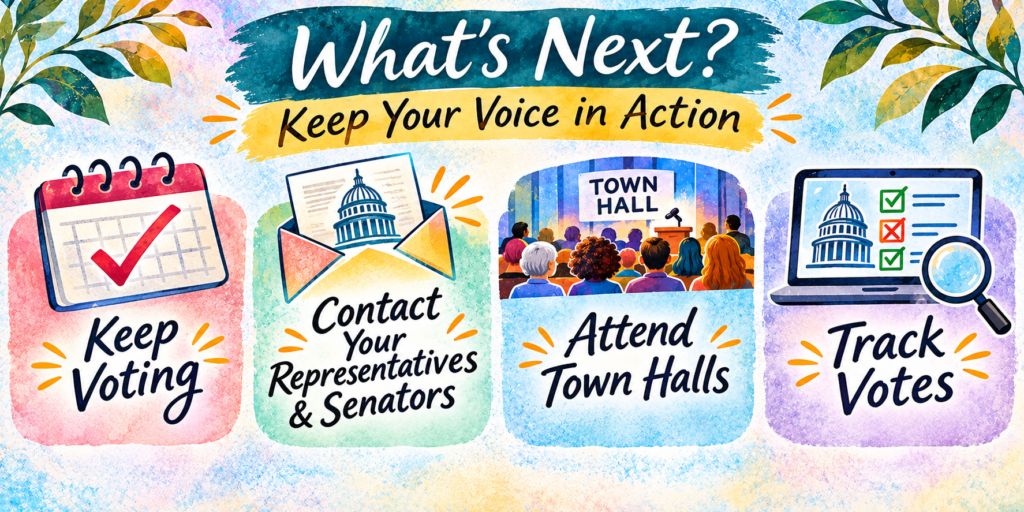
Graphic that calls the reader to action

Random acts of kindness

First, I want to admit to you that I’m in a long-distance love affair.

With New York City.

It’s a magical place for me — full of energy and possibilities and history and renowned architecture. Just walking around Manhattan makes me happy. I’m really into photography and constantly visualize photographs whether or not my camera is handy. NYC is full of great photographic moments. Here’s one such moment I captured in Washington Square Park, one of my favorite places:

Handsome man in Greenwich Village

On my second trip to NYC, my friend Leah and I were walking in Chelsea. It was about 6 p.m. Two scantily clad young women and a guy were arguing. In particular, the blond with twig-like arms and low-slung skinny jeans stumbled toward us, drunk, crying and yelling at her friends. She appeared to be incredibly distraught.

“I just want to die,” she screamed.

With the bitterness of a scorned woman, I said “I bet this drama is over a man. Let’s go talk to her.” We’ve all been there, right, ladies?

Leah’s motherly instinct took over. We ended up talking to the anorexic woman (let’s call her Marie) from Denmark, sitting on the sidewalk, for about an hour as the sun set. Leah stroked Marie’s hair and arm and listened to her plight. She explained why suicide wasn’t the answer, that the guy wasn’t worth Marie’s time. Marie had been hospitalized for anorexia for six months. We knew she was in bad shape.

Marie planned to move into a house in Brooklyn, where she lived for free with other young women. The only requirement was to hang out at the owner’s bar a few times a week. I asked “Do you have to have sex with the customers?” She said “no”, however, I knew. Later I learned that my hunch was probably right on. Sex trafficking is a big problem in NYC.

I was most impressed with Leah’s compassion towards this stranger. While I would have stopped to talk and listen to the woman, I probably wouldn’t have touched her. I have to know a person fairly well to go that far. Haaa.

We ended up persuading this young bony model to eat dinner at a nearby diner. Marie first ordered a wedge of iceberg lettuce topped with plain tuna fish. “I don’t care if I get fat!” she repeated in her Danish accent. “It doesn’t matter” as she ordered a piece of chocolate cake. To “get fat”, this woman would have to eat a cake a day for two months. Leah and I tried not to laugh.

Marie’s friend from Brooklyn picked her up from the diner, and Leah and I caught a cab back to the hotel.

We spent three hours trying to help Marie, and yet I knew her future looked bleak. A few weeks later, Marie texted Leah a photo of her with the sleazy boyfriend. Some lessons are hard to learn.

I Don’t Know

How often do you wonder why?

I wonder why a lot, trying to make sense of all kinds of things. Usually, an answer makes itself apparent. Now, I’m flummoxed.

On March 16, 2013 at Artspace in downtown Raleigh, I walked into a gallery to find a wall lined with dozens of small watercolors, each fastened with tiny nails. Several things about this art struck me as unique. The simplicity of nailing unframed art to a wall. Vivid color breezily layered over nostalgic photos. Sardonic, some suggestive, subtitles penciled in all caps. Obscured faces and headless bodies and bodyless heads.

The painting below, in particular, captured my imagination. Why?

painting by Pete Sack
Everyone Has a Riot Inside Them by Pete Sack

I don’t know what this painting signifies for me. But it made such an impression, I took this photo and posted it on Flickr and Pinterest. The image has haunted me ever since.

That was several years ago. I later wandered into Artspace and discovered the friendly artist in his workshop. (I expected a menacing man with a dry, dark sense of humor.) And the painting shown above — Everyone Has a Riot Inside Them — was buried in a stack. Now it’s hanging on my wall, fastened atop a white matte in a simple black frame.

Now that I think about it, Warhol’s more interesting portraits come to mind. Elizabeth Taylor with her smeared red pout and Marilyn with the Pepto Bismol mask. Could this explain the fascination? No, it’s not that simple.

The best art captures one’s imagination and doesn’t let go.

p.s. The artist explains what inspired him in this article.

Overcome labels and change the world

Last Sunday, I listened to a string of Harvard Business Review podcasts while raking the yard. This was the first raking of the season. Even with a tiny yard and a wide rake, I was out there until sunset.

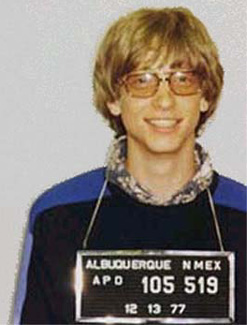
Bill Gates' mug shot
Photo ~ Bill Gates, dyslexic and a criminal. There’s hope for everyone.

HBR interviewed cognitive psychologist Scott Barry Kaufman regarding his latest book, Ungifted: Intelligence Redefined. The most important point is that labeling kids as “dyslexic”, “shy”, “autistic”, etc. disregards their innate gifts. And dysfunctions can trigger a different area of the brain to compensate. Today’s dyslexic child might be a new incarnation of Bill Gates.

Some kids never get past the label. Others fight hard to overcome the barriers erected by family, friends, and society.

I’d been thinking about the topic of overcoming labels after watching the documentary Diana Vreeland: The Eye Has to Travel, the story of the infamous and fabulous fashion editor.

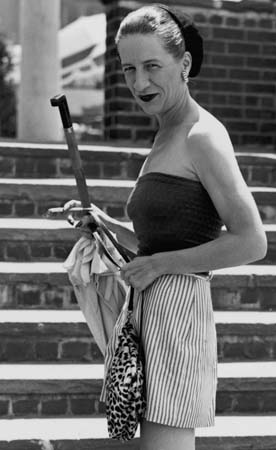
Diana (pronounced dee-ahna) Dalziel was labeled the “ugly” sister. Alexandra Dalziel bore the traits of a classic beauty — symmetrical proportions and sunny blond hair. Diana, with her dark hair and large nose, never measured up. Her mother proclaimed, “It’s too bad that you have such a beautiful sister and that you are so extremely ugly and so terribly jealous of her. This, of course, is why you are so impossible to deal with.”

Fashion editor Diana Vreeland
Photo ~ Fashion editor and icon Diana Vreeland: the “ugly” sister

Diana spent life promoting the innate beauty and unique qualities of women, and celebrated her own uncommon beauty. The pages of Harper’s Bazaar and Vogue featured women with prominent noses and gapped teeth rather than only cookie-cutter beauties.

Undaunted Diana Dalziel Vreeland overcame the “ugly” label. The women who pored over those magazine pages were forever changed.

Don’t stop at “dyslexic”, “special needs”, “ugly”, “slow”, “worthless”, “evil”, “doomed”, “lazy”, “dummy”.

Prove the labellers wrong.

What is or was your label?

Masterful monologue from Masters of Sex

The fascinating new Showtime series Masters of Sex is based on the story of Bill Masters and Virginia Johnson, pioneers of research about human sexual behavior.

The truths of intimate relationships abound in this show. Here’s just one example.

Allison Janney in Masters of Sex
Photo ~ Margaret Scully’s pained plea

The wife of the university provost, tired of being ignored, stumbles into her own affair. Recently dumped by her lover, she sits recovering at the bar and, by chance, strikes up a conversation with (unknowingly) her husband’s young male lover. Her husband walks in to meet the guy, and the truth silently reveals itself.

Allison Janney, who plays the provost’s wife, shined tonight with her pained plea to the young man:

Stay single.
I only say this to you because, when you’re young and in love, everyone thinks they’ll be the exception.
Sure, maybe Mom and Dad slept in separate beds and then separate rooms.
Maybe the older couples you know bicker or fight.
At your age, you can’t imagine it will ever be you
but it will be,
which is bad enough, but what’s even worse
is how much you’ll feel like a failure.
Because when the person who knows you best loses interest
that really takes something out of you
like surgery almost
and you really start to wonder
if you’ll ever be whole again.

Even those of us who don’t miss a single minute of those old relationships can identify.

Keep it simple: cast nice people

Have you ever compared your life to a movie, for which you are writer and director?

Who are your co-stars?
Who’s in a cameo role?
And which actors should be fired?

Appreciate Oscar-worthy co-stars. I’ve learned invaluable lessons from Jessica, Sally, Pamela, and Kellen. For example, avoid interrupting a story with your own anecdotes. Don’t judge. Balance your desire to protect one from pain with the knowledge that life is pain. We’ve made some great movies together.

Some actors in cameo roles deserve Oscars. Betty is cast in that role. Wicked sense of humor, a great listener, full of wisdom, and, most importantly, boldly herself. She inspires me to be a more generous, compassionate person.

Keep it simple. Cast nice people.
Photo ~ Or keep it simple. Cast nice people.

In lieu of an Oscar, learn how to give good hugs…a hard lesson for some of us.