Who I Voted for and What’s Next

In the 2026 US midterms, I voted not only from my bank account but from my heart. I voted for the people and values that shaped who I am, the women, the immigrants, Ukraine, and children. Here I explain why and point out what’s next.

Graphic showing a diverse range of people, urging Congress to support the issues they care about.

Women

I believe a woman’s body is her own. A woman should have the right to decide whether to continue a pregnancy, in consultation with her doctor and her own conscience, not a legislature.

I feel this strongly because I know what it’s like to live in a body other people feel entitled to judge and control. I grew up in a world that taught me that one of the greatest accomplishments a woman could achieve was being thin. Overweight women were (and still are) seen as weak and lazy. No law dictates my weight. But the attitude behind that judgment, that a woman’s body is everyone’s business, is the same one behind laws that take medical decisions out of women’s hands. I believe a woman has the right to decide what happens to her own body.

Immigrants

I voted for immigrants because they built this country and keep contributing to it every day. When immigration sweeps filled the news, I was afraid for people I care about. Friends of mine came to this country and have followed the rules to be here. I still worry that one of them could be taken. Losing a friend like that is a fear no one should have to carry. I also thought about the millions of immigrants who pick our vegetables, cook our food, make scientific discoveries, develop our software, and build our houses.

Ukraine

I want our country to stand with people who are standing up for their freedom. Friends in Ukraine describe the missiles and drones that strike Kyiv and other cities. Every night when the sirens go off, they take shelter, afraid for their lives. They lose electricity and water, and they can’t walk down the street without fear. Some of them even move to areas of the country that are less of a Russian target. Still they refuse to give up. They are fighting fiercely and bravely for their land, and I am continually in awe of them.

I voted for Ukraine because I want our country to stand with them in a timely manner. This fall, the US approved the sale of 500 Patriot missiles, but they haven’t been built yet. Ukraine’s president says deliveries might be years away. People are sheltering from missiles tonight. Aid that arrives years late isn’t help. It’s a promise. I want Congress to push for getting Patriots there now, including from existing stock.

Children

Helping young people achieve their dreams and live healthy lives isn’t charity. It’s an investment in all of us. I don’t have children, but I care about them. I want hungry kids to get free meals at school. I want them to have the healthcare they need to grow up healthy. And I want them to be able to dream about their future and have plans they can actually achieve. A child who has enough to eat, a doctor to see, and room to imagine has a real chance.

What’s Next?

Voting is the beginning. Now it’s time to make sure your representatives take action on the issues you care about.

  • Find your representatives and senators at house.gov and senate.gov, or call the Capitol switchboard at 202-224-3121 and ask for your representative’s or senator’s office.
  • Call or write about a specific bill, not a general feeling. Staff tally constituent calls and emails by issue; a specific one is seen as more important than a general feeling. For instance, call your senators about speeding up Patriot deliveries to Ukraine, not just that you’re angry about Russia’s invastion of Ukraine.
  • Track their votes, then tell them you noticed. For Congress, IssueVoter is a nonpartisan tool that alerts you before votes and shows how often your lawmakers vote your way. For Oklahoma’s state legislature, see the House floor votes page.
  • Show up to town halls when they happen.

Your voice reaches farther than a ballot. Keep using it. This country belongs to all of us.
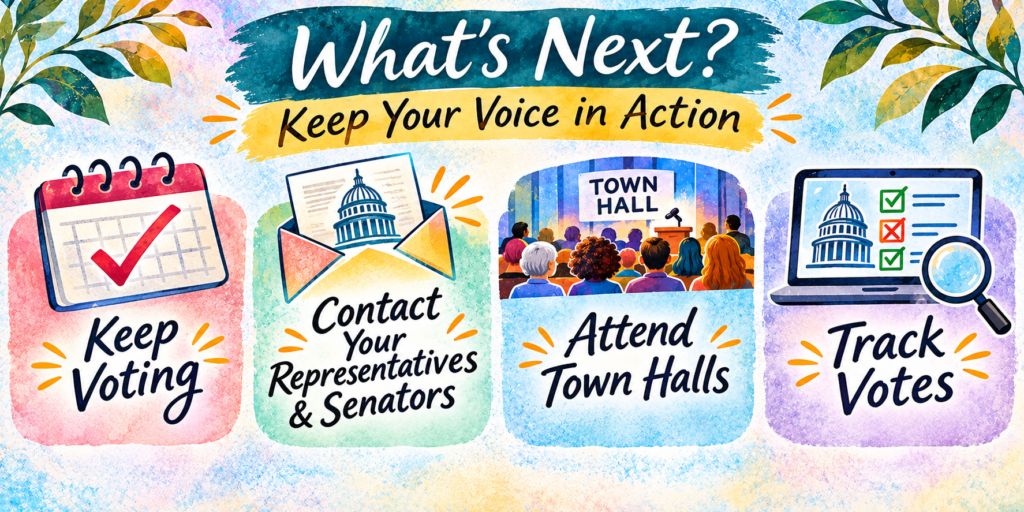
Graphic that calls the reader to action

Painting Sorrow

earth-colored rainbow hugging an immigrant's house

In 2025, U.S. Immigration and Customs Enforcement (ICE) began abducting non-white folks off the streets. They claimed they planned to deport criminals. However, studies show (TRAC Reports, Cato Institute, and Econofact) that most of these folks were not criminals.

I saw innocent folks being beaten and dragged into unmarked vans by masked, gun-toting agents and disappearing for months while the processing took place. Or worse, being killed.

One day, I was inspired to paint a rainbow over an immigrant’s house. The rainbow tightly hugs the house, protecting the inhabitants from danger. Instead of the typical brightly colored rainbow, I used earth tones. Perhaps the muted colors felt comforting? Perhaps they represent the color of the inhabitant’s skin? I felt a sense of sorrow and catharsis during the process. This is my first watercolor painting, and I’m happy with it.

I can’t fix this problem, but I can call my representatives. 5 Calls is an app that provides a short script and your representatives’ phone numbers. You simply click the phone number and read the script. That’s it.

Phone calls and protests hampered the madness in Minneapolis. Community resistance has made a difference elsewhere too. There’s more work to do. Keep fighting!

I quit, then I didn’t. What stained glass taught me about persistence and perfectionism.

Last year, I took a stained glass class in Oklahoma City. The class met once a week, and you could continue to use the workshop to create your stained glass pieces. Spotify filled the workshop with the best music from the 70s through 90s. Folks were friendly and encouraging. It was a creative utopia in the middle of OKC.

I found that making stained glass art was challenging and a great chance to stretch my creative chops. I loved picking out the glass, choosing colors and textures, and finding interesting patterns. Pinterest became my best friend for patterns.

stained glass art showing the sunrise over green hills heart, bee, and turtle stained glass art

Cutting textured glass can be challenging at best, especially for a beginner. While trying to cut one textured piece, I couldn’t press the glass scorer deep enough. The glass wouldn’t break. After much finagling, I screamed “I quit. I’m done!” Uncharacteristic for me. The once quiet, utopic workshop fell silent. I rushed out to take a breath. The instructor’s wife ended up cutting that piece for me.

A month later, the instructor asked me if I enjoyed the class. I explained that sometimes I get frustrated because I’m still learning. He said I should be “happy 100% of the time.” Really?

Utopia should not be forced. His statement was very demotivating and surprising in any art class. The next week, I decided to finish my current piece and end my stint in the workshop. It was a difficult decision at first, because Wednesdays had become a highlight of my week. But I realized the atmosphere wasn’t conducive to continuing to learn.

I hadn’t realized that stained glass is difficult to cut even for experienced artists. Now I realize that my perfectionistic tendencies affected my enjoyment of the process. I will continue to make stained glass art in the comfort of my own home. It will be messy but worth the final product.

Stained glass taught me that imperfection is part of the process. Glass is not perfect, and my skills are not perfect. The point is to enjoy the process and create a more beautiful world.

Have you dealt with perfectionism while creating your art?

Alt Text That Works for Humans and AI: A Writer’s Guide

Accessibility standards and generative AI tools shape best practices for alternate text on images.

Alt text provides a concise description of the image. Screen readers, which visually impaired readers rely on, speak the text. Generative AI tools also use alt text to interpret the image.

Example: “Network diagram showing three tier architecture with web, application, and database layers.”

Guidelines:

  • Screenshots in procedural steps:
    Provide descriptive alt text only. Human readers and AI agents use context and position to interpret the screenshot. Do not include visible descriptions above screenshots. This impedes readability and interrupts procedural flow.
  • Complex diagrams:
    Include a brief description above the diagram to orient all users before they interpret the visual. Also provide alt text.

How do you use alt text in a document?

AI Won’t Replace Technical Writers. But Technical Writers Who Use AI Will Replace Those Who Don’t

Technical writers face a paradox in 2026: AI promises to replace us while simultaneously becoming one of our most helpful tools. Here’s how I’ve navigated that paradox to reduce project completion time by up to 30% without sacrificing quality.

The truth about AI in documentation:

It’s a powerful first draft generator and a useful reviewer. It is not a technical writer.

My AI workflow:

I use ChatGPT and Microsoft Copilot as initial generators, not finished product creators. I provide the topic and objective and let AI produce an initial draft. Then the real work begins.

What I bring that AI can’t:

  • User advocacy: I anticipate the questions users will ask. The stumbling blocks. The missing context. AI generates information. I generate understanding.
  • Context reading: Copilot regularly suggests edits that can be contextually wrong. Recognizing that difference requires human judgment.
  • Style guide enforcement: Consistency across documentation requires knowing the guide AND knowing when to apply it. AI doesn’t do this reliably.
  • Fact checking: AI sounds confident when it’s wrong. I verify everything.

What’s your experience using AI in your documentation workflow? I’d love to hear how other writers are navigating this issue.

My First Visit to New York City

Visiting New York City had always been a dream of mine. So many of my favorite artists lived there — Rothko, Rauschenberg, Frankenthaler. I dreamed of visiting the Museum of Modern Art (MOMA) and the Met to see all of the grand art I’d studied in college. And I admit that my obsession with Sex and the City influenced my travels there.

When one of my favorite Broadway plays hit the scene in 2014, I could no longer procrastinate. I booked an AirBNB special in the hip artsy Williamsburg neighborhood of Brooklyn off Varet and Bogart. It was fine for $60/night. Perfect location, close to the metro, quiet, and relatively safe.

Here are a few of my favorite photos. Visit flickr.com for more.


Reflections from the Lisa Perry store on Madison Ave.
Ralph Lauren store display
Running to work
Businessman
Drama student in Washington Square Park
The Cellar at Beecher’s Handmade Cheese
Front porch
Dandy menswear
Lichtenstein at the MOMA
Zoe Leonard’s camera obscura at the Whitney museum
Poster for Hedwig and the Angry Inch at the Bellagio
Zoe Leonard's camera obscura
Zoe Leonard exhibit at the Whitney
High Line walkway in Chelsea
Taken from the High Line walkway in Chelsea
High Line walkway in Chelsea
On the High Line
High Line walkway in Chelsea
On the High Line walkway in Chelsea
Times Square
The ubiquitous Times Square pic
Mom's motto
Mom’s motto (and quickly becoming mine)
Graffiti in Brooklyn
I’d rather be birding in Brooklyn

Take advantage of LinkedIn in your job search and beyond

LinkedIn profile for Sheila Loring

After spending almost 12 years writing product documentation (and working on a host of other projects), I decided it was time to try something new. I was also ready for some time off. Time to return to my old buddy LinkedIn.

LinkedIn provides many benefits if you’re looking for a new opportunity. And folks who want to stay connected with friends and coworkers might also find LinkedIn useful. It’s a great place to share ideas, ask questions, and learn about workforce news, interviewing, and more.

I’ve learned a lot about LinkedIn in recent months. Here are a few tips for newbies and for those who need a refresher.

  • Take advantage of LinkedIn even when you’re not on the job market. Connect with friends and coworkers, keep your profile and experience sections up-to-date, and write and share posts a few times a week. Make sure those posts are professional. LinkedIn is not Instagram or Facebook. The point is to remain fresh on the minds of your network and other LinkedIn users. They might present you with a job opportunity that you can’t pass up.
  • Invite coworkers to write recommendations. Recruiters can easily read them without requesting references. If you’re working, it’s easier to ask for a recommendation about a specific project or skill when it’s fresh on your mind. Don’t forget to write your own recommendations for those who’ve impressed you on the job or in volunteer roles.
  • Have you read posts by other LinkedIn users that particularly resonate with you? Follow them to see their updates in your news feed. At the top of their profile page, click the green +Follow button. I bet you’ll come across a post that enriches your career or inspires your job search.
  • Save posts that interest you to revisit them. They’re listed at https://www.linkedin.com/my-items/saved-posts/, which only you can see when logged in. The posts are also linked on your profile in the Resources section. This is helpful when you don’t have time to read and want to scan the post later.
  • Take free LinkedIn courses. Learn about Python or cryptocurrency. Learn how to write a cover letter or how to use lists to increase your productivity. Consider sharing what you learned in a LinkedIn post or on another social media site. Maybe one of the courses will spark your creativity and benefit you on the job, or you’ll find a new skill to add to your profile.
  • LinkedIn is not just for the tech industry. I’ve worked in that industry, so I’ve been tech-focused. However, many industries are represented on LinkedIn — higher education, health care, retail, and others. See LinkedIn Industries List & Rankings (2022).

There’s so much more to know about LinkedIn. I suggest taking a look at the following articles:

Lastly, here’s my LinkedIn profile page. It’s by no means perfect or complete because I’m learning every day.

What are some of your favorite aspects about LinkedIn? How has it enriched your career? I’d love to hear from you.

My First Painting in Decades

My first attempt at painting in decades. Tempera on mixed media paper. It’s too washed out, but I’m happy with the blue and pink colors and the texture. The seam is where I taped two pieces of paper together.

pink and blue abstract painting

I’m taking an online class from @pattyripley. She teaches you how to get out of your head and paint intuitively. We start with stretching, meditation, and a little dancing just to loosen up the mind and body. Woo hooo, me, dance? Luckily it’s only in my living room over Zoom.

I’ve been picking up some odds and ends to create texture, like a spatula with holes and a pastry blender, and I’d like to get some lace. (I used a garlic grater for this painting.) I’d also like to go full Rauschenberg and pick up some old scraps at Goodwill to glue here and there. Though if I really wanted to practice Rauschenberg’s technique, I’d pick up the scraps from the streets.